Skip to content
Basics 7 min read

Why Daily Practice to Learn Coding With AI Beats Marathons

Daily practice to learn coding with AI builds durable skill faster than weekend binges. Try the simple, Duolingo-style method and start your streak today.

By VibeGym Team ·

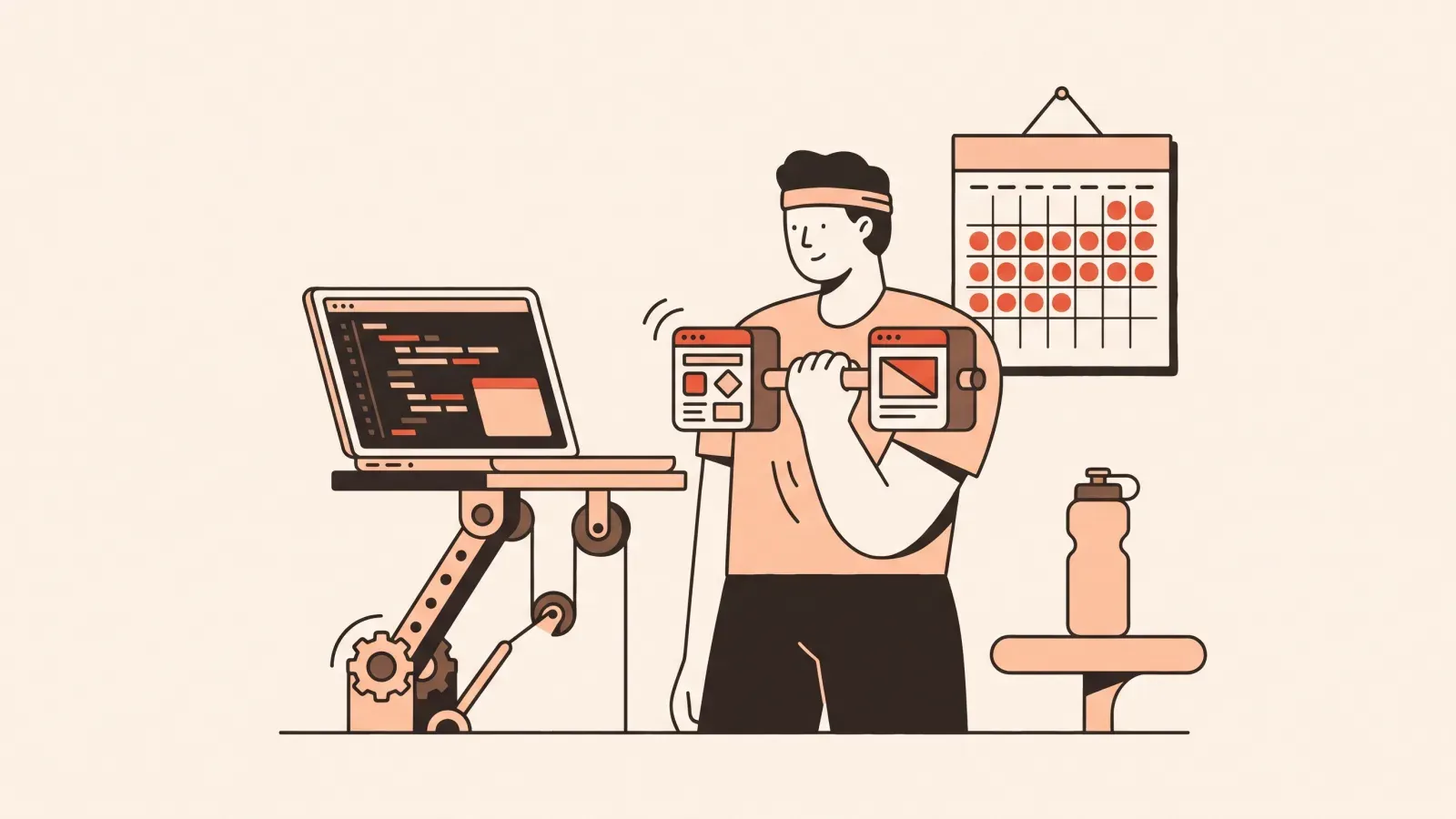
Illustration of a person lifting a small dumbbell made of app blocks in front of a laptop, with a streak calendar on the wall

Why 5 minutes a day beats the weekend marathon

If you want to learn building with AI, your instinct probably says to block out a whole Saturday, brew the coffee, and go deep. It feels productive. It rarely works. The most reliable way to build a real, lasting skill is daily practice to learn coding with AI in tiny doses — five to fifteen focused minutes, most days, on purpose. This is the same logic behind language apps like Duolingo, and it applies just as well to directing AI tools to build software.

This is not a motivational slogan. It is how memory actually works. Below is the light science, then a practical habit you can start this week.

The binge-then-forget trap

A weekend marathon has three quiet problems.

First, fatigue. After an hour or two of wrestling with something new, your attention drops and your error rate climbs. The last two hours of a five-hour session teach you far less than the first one did — but they cost just as much willpower.

Second, the forgetting curve. Psychologists have studied this for over a century: after you learn something once, you forget most of it within days unless you revisit it. A single big session gives your brain one chance to encode the skill, right before a long gap where it quietly fades.

Third, it is hard to repeat. A heroic Saturday depends on a free Saturday. Miss two weekends to life and travel, and you have done almost nothing for a month. A five-minute rep fits into a coffee break, so you actually keep doing it.

The result is a familiar cycle: a burst of effort, a long silence, and the deflating discovery next time that you have to relearn half of what you “knew.”

What the science actually says

Two ideas do the heavy lifting here, and neither requires a psychology degree to use.

Spaced practice (or spaced repetition). Spreading your reps out over time — a little today, a little in two days, a little next week — produces much stronger memory than cramming the same total minutes into one sitting. Each time you successfully recall something just as you were about to forget it, that memory gets reinforced. The gaps are not wasted time; the gaps are the point.

Active recall. Reading about a concept or watching someone do it feels like learning, but it is mostly recognition. Real learning comes from doing the thing yourself and struggling slightly — writing the prompt, reading the AI’s output, spotting what is wrong, fixing it. That mild effort is what moves a skill from “I have seen this” to “I can do this.”

Put them together and you get a simple rule: short, frequent, hands-on reps beat long, rare, passive ones. A daily streak is not a gimmick — it is a visible tally that keeps the spacing tight enough to work.

Why this fits AI building especially well

Directing AI to build software is a skill of judgment, not memorization. The hard part was never typing the code — the AI does that now. The hard part is scoping an idea, writing a prompt the tool cannot misread, verifying that the result actually works, and debugging calmly when it does not. (If “vibe coding” is a new term, here is a plain-English intro to what vibe coding is.)

Judgment is exactly the kind of skill that rewards many small reps. You cannot cram instinct. You build it the way you build any instinct: by making a small decision, seeing the outcome, and adjusting — over and over. A short daily drill where you prompt a tool, read what it produced, and decide whether to ship or fix it trains that loop directly. A six-hour binge, by contrast, often turns into copying one big tutorial start to finish, where you watch someone else’s judgment instead of exercising your own.

This is also why the skill transfers. Reps in one tool — Cursor, Lovable, Bolt, Claude — build the underlying instincts, so a new editor next year feels familiar instead of foreign. If you are still choosing where to practice, an honest comparison of beginner-friendly AI tools will help you pick one and stick with it.

A 5-minute daily practice to learn coding with AI you can start today

You do not need a course to begin. Here is a routine that respects the science:

  1. Pick one tiny target. Not “build my startup.” Something like “add a contact form to my page” or “make the AI explain one error message to me.”
  2. Do one rep. Write a single clear prompt, run it, and read the result. Five to fifteen minutes, then stop — even if you want to keep going. Stopping while it is still fun is what makes you come back tomorrow.
  3. Verify, do not assume. Check whether the output actually does what you asked. Noticing a subtle bug is itself a rep.
  4. Leave a breadcrumb. Jot one line: what you tried, what broke, what to try next. Tomorrow-you starts in two seconds instead of two minutes.
  5. Mark the day. Tick a box, keep a streak — whatever makes the chain visible. Protect the chain, not any single perfect session.

The goal is not to finish fast. The goal is to return tomorrow. Consistency compounds; intensity burns out.

Habit tips that make the streak survive real life

Knowing the method is easy. Keeping it going is the actual challenge. A few things help more than willpower:

  • Shrink the minimum until it is almost silly. On a terrible day, your rep can be a single prompt. A tiny rep keeps the streak alive and, more often than not, pulls you into a longer session anyway. Two minutes done beats thirty minutes skipped.
  • Anchor it to something you already do. “After my morning coffee, one drill.” Attaching a new habit to an existing one is far more reliable than relying on motivation.
  • Use a structured path so you never stall on what is next. Half of skipped practice is just not knowing what to do today. A clear next step removes that friction entirely.
  • Plan for the missed day. You will miss one. The rule that matters is “never miss twice.” One gap is noise; two in a row is how habits quietly die.
  • Aim for a small finished thing. Reps feel more rewarding when they point at a real, shareable result — a live page, a working form — rather than a sandbox exercise you throw away.

Key takeaways

  • Spaced, daily reps beat weekend marathons because memory fades in the gaps a marathon leaves behind.
  • Active recall — doing it yourself — teaches far more than watching or reading, and AI building is mostly judgment, which only reps can train.
  • A streak is a tool, not a vanity metric: it keeps your spacing tight enough to actually work.
  • Make the daily minimum tiny so real life cannot break the chain.

A few honest questions

Is five minutes really enough to learn anything? Five minutes is the floor, not the ceiling. Some days you will naturally do twenty. The point of the small number is that it is impossible to skip, which keeps the habit — and the spacing — intact. Many short sessions add up to far more retained skill than a few long ones.

Where should a complete beginner start? With one tiny project and one tool. A step-by-step first website with AI is a friendly first target. Pick one tool, build one small thing, and let the daily habit do the rest.

Do I need an app for this? No. A notebook and any AI editor will do. The advantage of a guided system is that it picks tomorrow’s drill for you, spaces older skills back in before you forget them, and keeps the streak visible — so you spend your five minutes practicing instead of deciding what to practice.

That last part is exactly what VibeGym is built around: short daily drills across the skills that matter — Foundations, Prompting, Debugging, and Security — with spaced repetition and a streak doing the remembering for you. A two-minute quiz sets up a plan, and the free plan lets you start the daily habit without paying anything. Whichever way you practice, the rule is the same: small reps, most days, beat the marathon you never repeat.

#daily habit#learning#vibe coding#beginners#spaced practice